What does the word mulsangdo mean?
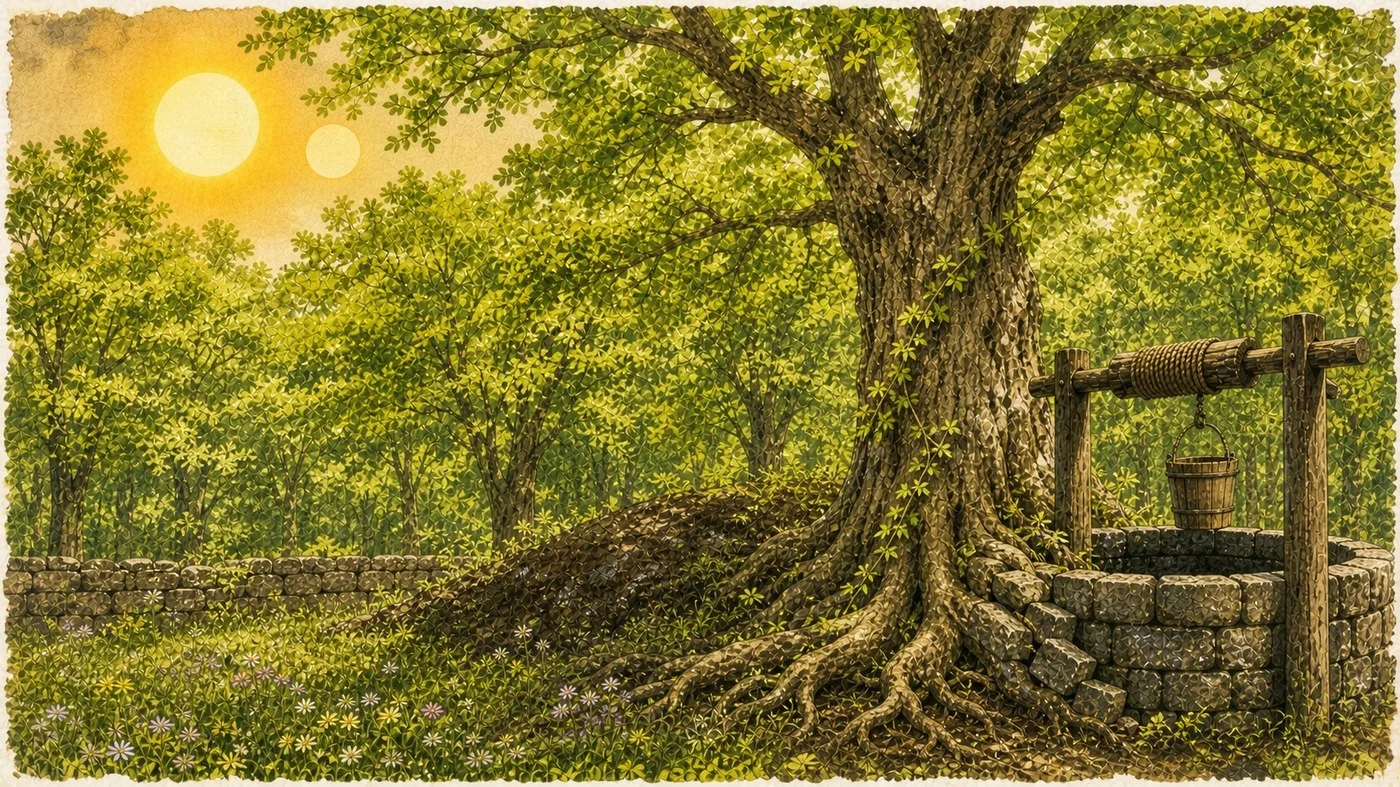
The word has three parts. Mul (物) means things, sang (象) means their shape or image, and do (圖) means a picture. Put together it is a picture of things: the characters of a saju (사주) chart, the Korean reading of the four pillars of birth, turned into objects you could point at and then painted as one scene.
It grows out of an older way of reading called mulsang, where Gap (甲) wood is read as a tall tree, Byeong (丙) fire as the sun and Im (壬) water as a wide river. Mulsang is the method. A mulsangdo is that method applied to one person's eight characters and actually set down as a picture. There is one method, and there are as many paintings as there are people.
What goes into one painting?
Every mulsangdo holds the same six things, arranged differently each time.
- The main figure. The upper character of the day you were born, called the day master. It stands in the middle of the frame.
- The sky. The other upper characters become sun, moon, cloud and rain.
- The ground. The lower characters become mountains, fields, rocks and water's edge.
- The season. Set by the month of birth. The same tree is a new shoot in spring and a bare trunk in winter.
- The weather. How cold or hot, dry or wet the whole chart is decides the air and the texture of the ground.
- One living thing. Even in an empty landscape, something small and clearly alive is left somewhere in the frame.
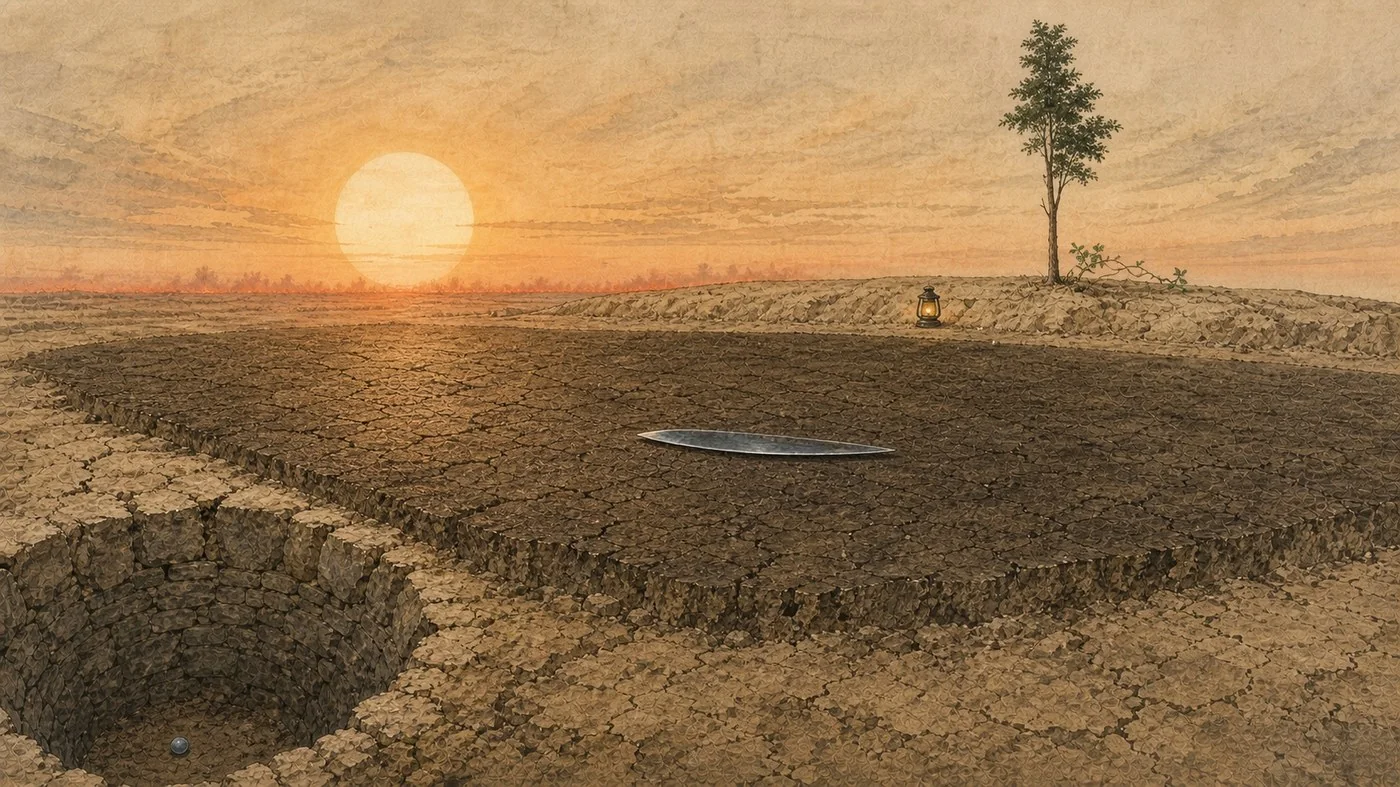
What the painting means lives in what those six are doing to each other. Is the axe shaping the tree or standing over it? Is the lamp heating the iron? Is the water reaching the dry field? A row of objects is a field guide. A painting starts when something happens between them.
How is the weather decided?
A saju chart has a temperature and a humidity. Korean readers call this hannanjoseup (한난조습): cold, warm, dry and wet. The month of birth lays down the base, so a winter birth starts from the cold side and a summer birth from the warm side. The other characters then shift it a little. They cannot turn the season over. Water in the chart of someone born in July is warm water, not cold.
| Chart | What you see in the painting |
|---|---|
| Cold and wet | Frost, thin ice, low mist |
| Cold and dry | Frost needles and a dry wind, no mist |
| Warm and wet | Rising steam, heavy air |
| Warm and dry | Heat haze, cracked ground, short shadows |
What happens when an element is missing?
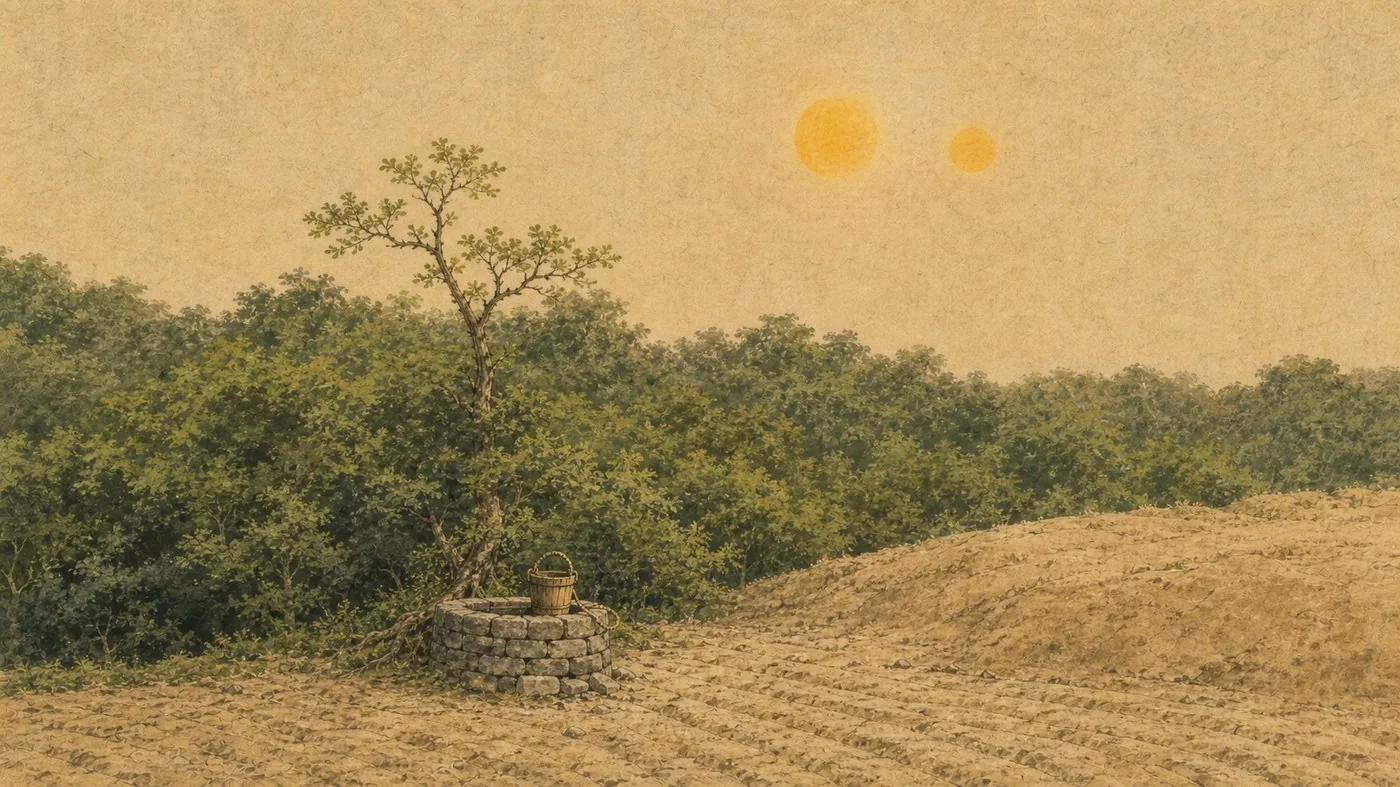
What is not in the chart is not in the painting. With no water anywhere in the eight characters, no water is painted: the ground is dry and the well shows its bottom. With no fire, no sun is put in the sky.
Absence is never painted as ruin, though. Ruin says it is already over. Empty space says it has not arrived yet. So a dry channel the water will run down, or a bucket ready to be lowered, is left somewhere in the frame. How a missing element is read in practice is on the page about balancing the five elements.
How do you read your own mulsangdo?
Look at three things, in this order.
- Find what stands in the middle. That is you. A tree, a sun, a rock or a river.
- Read the weather. Warm or cold, damp or dry. That is the air you are standing in.
- Find the empty place. What the painting lacks is what your eight characters lack. Then look for the small thing left beside it. It points at what is still to be filled.
Those three are enough to get the shape of a chart before the first page of the written report.
Why a painting and not a chart table?
A table gives you counts: three wood, one fire, no water. Nothing in it is wrong, but it does not stay in the memory and it does not show what the elements are doing to each other. A painting is taken in at once. Look at one tree on a dry hill and you know what it is missing without being told. A mulsangdo exists to hold the relations between eight characters in a single look. The fifty pages of the report take that picture apart piece by piece.
Can two people get the same mulsangdo?
No. Identical sets of eight characters are rare, and even with the same day master a different season and different neighbours give a different landscape. A Gap tree in a spring meadow and a Gap tree on a snowed over mountain are two different paintings.
What a mulsangdo cannot do
It does not show the future. It shows the shape you were born with and the weather you are standing in now. What to do and when comes from reading the ten year and yearly cycles alongside it, and that is the job of the written report. A finished one can be seen on the sample page.
You are welcome to use the example paintings on this page anywhere: blogs, articles, class notes, videos. Just credit Mulsangjae (saju-report.com/en/mulsangdo) next to the image and link back to this page. They are shared under Creative Commons Attribution 4.0.
Reports are written in Korean at present. An English edition is in preparation and there is a waitlist for it.